Advantages And Disadvantages Of Serial And Parallel Data Transmission
Advantages of Serial Interface disadvantages of Serial Interface This page covers advantages and disadvantages of Serial Interface. It mentions Serial Interface advantages or benefits and Serial Interface disadvantages or drawbacks. What is Serial Interface? In serial communication data bits are transmitted one after the other in sequential manner using single communication channel.
CBGVA is broken down to (THCVA) by the enzyme. Research [ ] THCV is a new potential treatment against obesity-associated glucose intolerance with pharmacology different from that of CB1 inverse agonists/antagonists. At that point, THCVA can be with heat or UV light to create THCV. Is studying plant-derived tetrahydrocannabivarin (as GWP42004) for type 2 diabetes in addition to metformin. Teploschetchik hydrocal instrukciya.
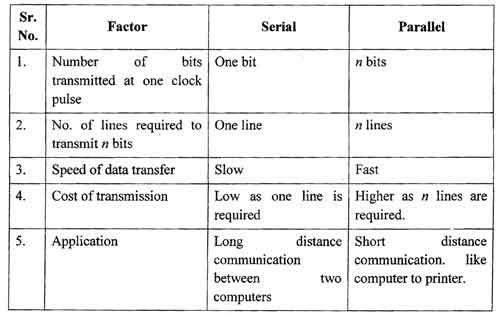
Advantages and DIsadvantages. Parallel connections are, all things being equal, faster due to a higher rate of transfer. However, parallel ports also require more hardware, making them more expensive to implement. Furthermore, data transfer rates have increased to such an extent that serial connections can transfer entire gigabytes per second. In Parallel Transmission, every bit needs a wire to transfer data from one place to. What are advantages and disadvantages in intercultural communication?
Example of serial interface is RS-232 which is point to point and asynchronous interface. It is used between devices (i.e. DTE and DCE). Protocol uses start bit and stop bit for data communication. Serial interfaces may have multiple lines but only one line is used for data communication. There are two methods in serial communication viz.
Synchronous and asychronous. In synchronous communication, block of data (or characters) are transferred at a time. In asynchronous communication, single byte (or bit) is transferred at a time. There are special ICs used for this communication such as UART and USART. The microcontroller IC such as 8051 consists of in-built UART chip. PISO and SIPO shift registers are used to convert serial data into parallel data and vice versa. Benefits or advantages of Serial Interface Following are the benefits or advantages of Serial Interface: ➨It uses less number of conducting wires, hence reduces cost of the interface.
➨It supports long distance data communication. ➨It uses less number of wires often only one, this leads to simple interface between transmitting and receiving devices or ICs.
It is easy to implement. Drawbacks or disadvantages of Serial Interface Following are the disadvantages of Serial Interface: ➨It uses less number of lines for transmission between devices. Hence it supports slower speed of transmission. ➨It occupies overhead of about 20% other than useful information. This leads to wastage of bandwidth meant for data trasmission for useless stuff. Also refer advantages and disadvantages of type. Advantages and Disadvantages of other wireless technologies.
Parallel versus serial communication. In and, serial communication is the process of sending one at a time, sequentially, over a. This is in contrast to, where several bits are sent as a whole, on a link with several parallel channels. Serial communication is used for all and most, where the cost of and difficulties make parallel communication impractical. Serial computer buses are becoming more common even at shorter distances, as improved and transmission speeds in newer serial technologies have begun to outweigh the parallel bus's advantage of simplicity (no need for serializer and deserializer, or ) and to outstrip its disadvantages (, interconnect density). The migration from to is an example.
Main article: Many serial communication systems were originally designed to transfer data over relatively large distances through some sort of. Practically all long-distance communication transmits data one bit at a time, rather than in parallel, because it reduces the cost of the cable.
The cables that carry this data (other than 'the' serial cable) and the they plug into are usually referred to with a more specific name, to reduce confusion. Keyboard and mouse cables and ports are almost invariably serial—such as. The cables that carry digital video are almost invariably serial—such as plugged into a port, a plugged into a USB port or, connecting an to a port,, etc.
Other such cables and ports, transmitting data one bit at a time, include,, Ethernet cable plugged into, the using previously reserved pins of the or the or the port. Serial buses [ ] Many communication systems were generally designed to connect two integrated circuits on the same, connected by on that board (rather than external cables). Are more expensive when they have more pins. To reduce the number of pins in a package, many ICs use a serial bus to transfer data when speed is not important.
Some examples of such low-cost serial buses include,,,,,. Serial versus parallel [ ] The communication links, across which computers (or parts of computers) talk to one another, may be either serial or parallel. A parallel link transmits several streams of data simultaneously along multiple channels (e.g., wires, printed circuit tracks, or optical fibers); whereas, a serial link transmits only a single stream of data.