Environmental Problems Of Kazakhstan Prezentaciya
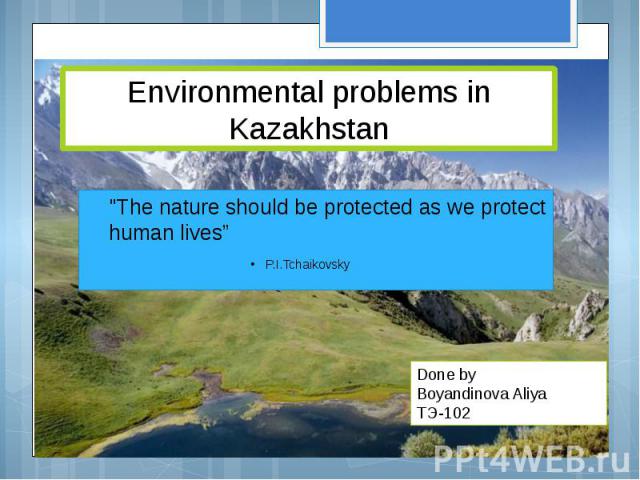
Currently, humanity has plenty of global environmental problems that it has to take care of now. Desiccation of the Aral Sea is one of the items on the list. The Aral Sea, is located in southwestern Kazakstan and northwestern Uzbekistan, near the Caspian Sea. The Aral Sea is still listed as the fourth largest lake in the world. Oct 13, 2014 - Air pollution in Kazakhstan is another significant environmental problem. Acid rain damages the environment within the country and also affects neighboring countries. Pollution from industrial and agricultural sources has also damaged the nation's water supply.
Ecology is a since which studies the relationship between all forms of life on our planet and the environment. This word came from Greek “oikos” which means home. The idea of home includes our whole planet, its population, Nature, animals, birds, fish, insets and all other living beings and even the atmosphere around our planet. People have always polluted their surroundings. Even in ancient times people admitted that their health was depending on the state of surroundings. But only in XX century humanity, in full measure, realized, that many diseases are closely connected with the air and water pollution and inferior products. • Since ancient times Nature has served Man giving everything he needs: air to breathe, food to eat, water to drink, wood for building and fuel for heating his home.
For thousands of years people lived in harmony with the environment and it seemed to them that the resources of nature had no end or limit. With the industrial revolution our negative influence on Nature began to increase. Large cities with thousands of steaming, polluting plants and factories can be found nowadays all over the world. The by-products of their activity pollute the air we breathe water we drink the fields where our crops are grown. Is an unwanted change in the quality of earth’s earths atmosphere caused by emission of gases due to burning of fossil fuel, transportation, industrial institution etc.
Source Pollution Transportatio n 42% Fuel 21% Industries 14% Solid waste disposal 05% Other 18% 1. Gaseous waste: Oxides of nitrogen, SO 2, CO.
• Use free body diagrams to draw position, velocity, acceleration and force graphs and vice versa. • Explain the effects with the help of a free body diagram. Zaryadnoe ustrojstvo kedr avto 12v instrukciya po primeneniyu. • Explain how the graphs relate to one another.
Cl, Br, I, O 3 & smog. Complex organic chemicals: Benzene, ether. Acid prop lets: H 2 SO 4, HNO 3 4. Agrochemicals: fertilizers, pesticides, herbicixles, fungicides, rematicides, weedicides, bectreci des etc.
Metals: Mercury, lead, Cd, Zn, Fe, Ni etc. Solid wasre: Garbage, plastic etc.
Radioactive waste: Nuclear reacters, uranium, nuclear explosion. Noise waste Different Pollutants. Natural Pollutants: The pollution which comes out from natural sources such as forest fires volcanic eruption decomposition of organic matter & natural radioactivity. Primary Pollutants: Harmful chemical that directly enters the air as a result of human activity. These are deforestisation burning of fossil fuel industrialization warfare etc.
Secondary pollutants: These result from chemical reactions between two or more air components. Formation of secondary pollutants 2 SO 2 +O 2 2 SO 3 +H 2 O H 2 SO 4 (Secondary pollutant). Modern smog is a type of air pollution derived from vehicular emission from internal combustion engines and industrial fumes that react in the atmosphere with sunlight to form secondary pollutants that also combine with the primary emissions to form photochemical smog.