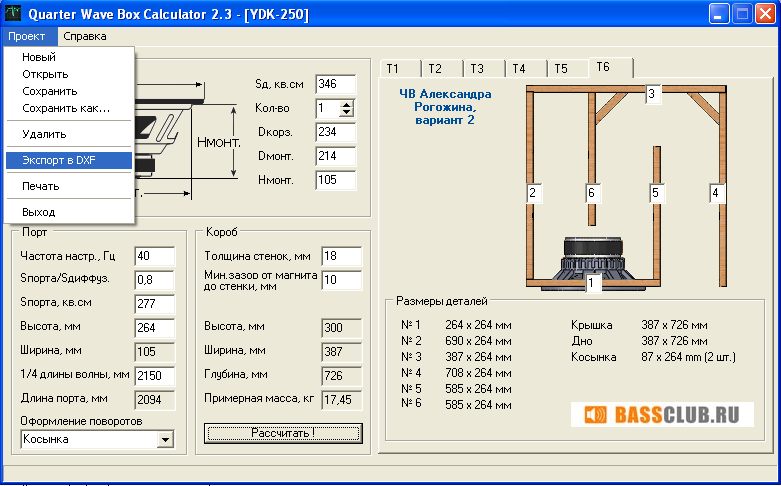
Quarter Wave Box Calculator
Pearls from Martin J King Quarter Wave Design Pearls from Martin J. King Quarter Wave Design An introduction by Bjorn Johannesen, Denmark. 11-december-05 The first time you visit, you might get overwhelmed by the tremendous work done by Martin J. I have with great interest studied the information on the site, and Martin has been very patient answering my questions. When I realised quarter wave design was not that mysterious after all, I decided to write this article, which has been reviewed by Martin. Without the very helpful support from Martin, this article could not have been written.
To fully understand the quarter wave design, download MathCad and the MathCad worksheets. They are available for private non-commercial use. Quarter Wave Design In a Transmission Line (I use the term TL for all types of quarter wave designs), the goal most often sought after* is to extend the bass by adding a lift to support the driver.
The output from the opening is a desired property of the quarter wave design, and the line should be relatively lightly stuffed. *[a TL may also be used to create a highly non-resonant enclosure in which the goal is to completely eliminate the back wave of the speaker (ie a desirable goal if you are working with a midrange or a tweeter), and of course there is a continuous spectrum between these two] Problems with TL A TL is a resonant system. The first (lowest) resonance is the one you want.
They can't be reduced to simple differential equations like normal boxes can. I know of for modeling transmission lines is Martin's site http://quarter-wave.com/. This calculator is not expected to give perfect results, but hopefully will be a good starting point. Qt of the driver used in a TQWT should be between 0.2 and 0.7,.
Cabinet pro cnc edition v201275 cracked free. Full version Cracked Soft For sale Linksafe site: Contact email: ted7590 @ gmail. Full version Cracked Soft For sale site: Contact email: ted7590 @ gmail. Cabinet Pro CNC 2012 Cracked. Siskiyou CabinetPro 2012 CNC Edition KCD 9.0.8.5 Cabinet. Microvellum OverDrive Pro 2012 v7.4 OEM Edition Enroute Pro 4.5.
Unfortunately, there are higher resonances as well. These higher harmonics are unwanted, because they cause an uneven sound pressure level with peaks and nulls (ripple). This problem can be minimized by one or all of the following: The geometry of the cabinet (tapered pipe), driver offset down the line and stuffing. But every time you solve one problem, you create another. This is the great challenge about quarter wave design. MathCad is a very good and proven tool to find the best compromises. Resonance Systems When you combine a pipe and a driver you are merging two mechanical systems to produce a new mechanical system with its own resonant properties.
You need to look at the driver as one system, the pipe as a separate system, and the driver in the pipe as an entirely new combined system. Figure 1: Transmission Line System and Infinite Baffle Impedance In this example, the driver resonance (F s) is 40 Hz. This is shown by the blue line.
The pipe is tuned to 40 Hz as well. Normally you would not set the pipe resonance equal to driver F s.
The red line is the combined system with the driver and cabinet, resulting in 2 new resonances. The first resonance (impedance peak) at 30 Hz is a combination of the air of mass in the pipe combining with the moving mass of the driver cone and voice coil oscillating on the driver's suspension.